Whakanuia te tangata ringa raupā
Eve Armstrong-Coop
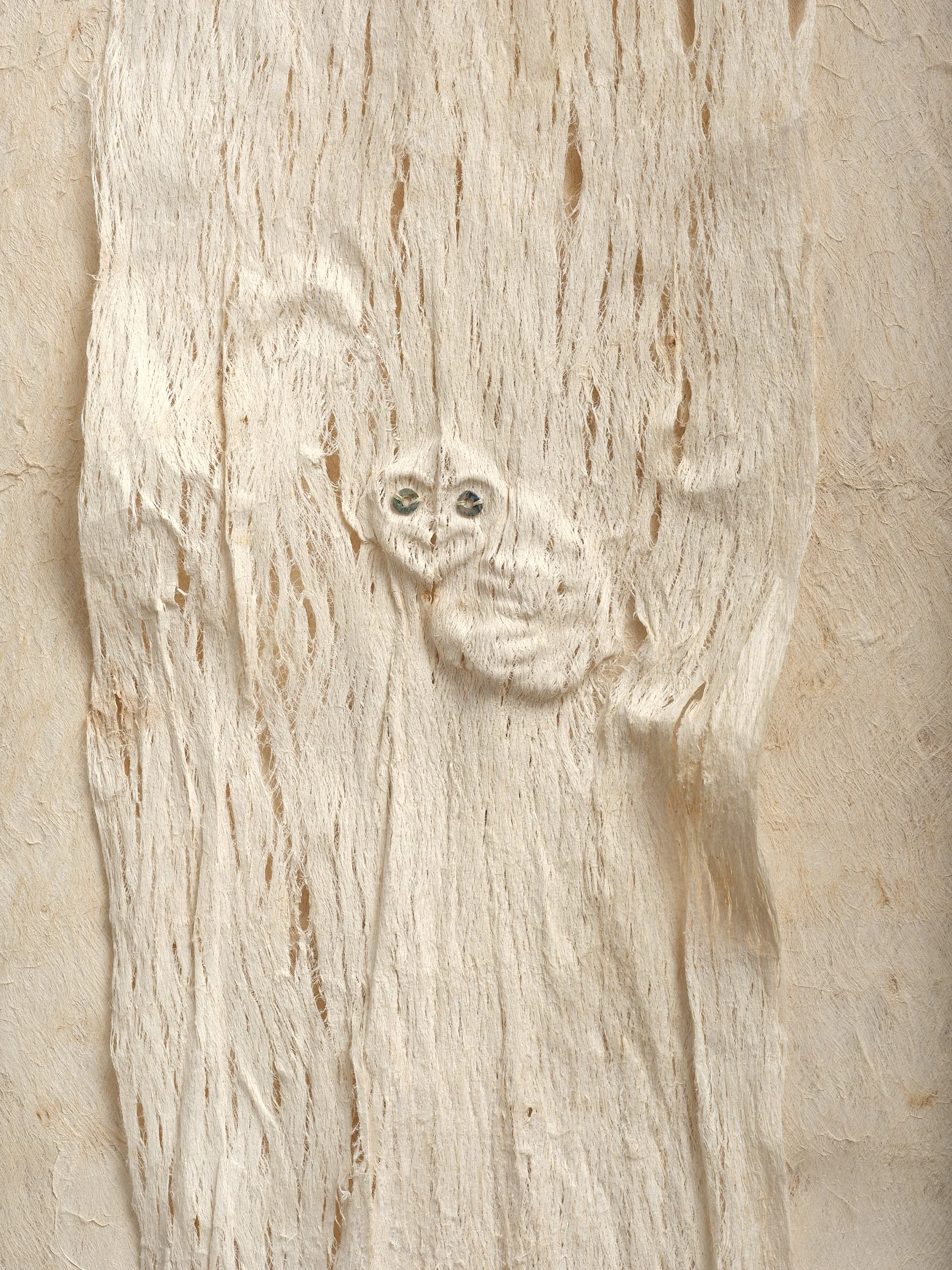
Atarangi Anderson Pou whakamauāhua,ngā tiki, 2026 Aute, muka, pāua 1730 x 380
Whakanuia te tangata ringa raupā is a commissioned essay by Eve Armstrong-Coop on the occasion of Mau Āhua by Georgia Tikaputini Douglas Hood and Atarangi Anderson.
She carves away at the leathered uku in long pearls. The pieces fall to the ground and collect around her shoes until she’s ankle-deep. Dust and ash and mud. Uku-covered nose and mata. She wipes clay from her hands, transferring it to her thighs. It’s thirsty work. Muscular, embodied mahi. Heavy on the body and mind. A quiet weight, laden with the grief of her tīpuna.
The haehae pattern reveals itself slowly, clay falling like blood. She gives a mihi to Hineukurangi, to Hineahuone, and Papa that the mahi moves open, doesn't snap shut or defeat her. It arrives naturally, gently - on the level of the subconscious. Like sunlight touching the shifting skin of awa and filtering down to seabed mud.
The same kupu - haehae - is used for an old practice. Carving the skin in grief. To take a broken pāua shell or piece of obsidian to the chest, releasing the māmae of loss. A call to Hine-nui-te-pō and a sign that one is angry or hurt. Pain - carved out.
The mahi continues. She’s carving out pain in strokes. Her mind remains quiet as she works; her fingers take calm control. Back to the whenua, inside the whenua with Papatūānuku and Hineahuone in hand.
Our people are great wayfinders. We know where we’re going, thank you very much. Tēnā koe. We are guided by great lineages of mātauranga, gifted through whakapapa and protected by tōhunga. I use the kupu ‘wayfinder’ and not ‘navigation’ as our people never relied on instruments to discover these waters. Despite your best efforts, dear coloniser, our methods are tried and true. Happiest of Valentines to you and yours.
In te ao Māori, wairua moves through life, distinct from the body and mauri. Incepting at the formation of the eyes, wairua is immortal and journeys to Te Pō following the death of the physical body. Aute cloth plays a utilitarian role in this haerenga, used at birth and at death to ensure proper spiritual protection. Care must be taken. The cloth, a product of Atarangi’s arduous, time-intensive mahi, performs this tikanga ritual for her whānau and others who want to honour the ways of onamata. Her art practice exists on a seperate plane, drawn from creative visual dream. So, the cloth and the maker find ways through realms - the utilitarian aspect informing and shaping the artistic.
Georgia is concerned with what comes after death - for tīpuna and uri, for those who move on and those remaining. In finding a way through grief. The uku, her medium of sorrow and triumph, becomes a vehicle for processing intergenerational grief. She is attracted to the amphora form as a method to configure tīpuna, placed on the plinth with the koha of space and reverence. It is a bringing forth of these ancestral bodies so they are felt and beloved by the onlooker, by the artist. To hold their essence in whenua.
We’re sitting at the bar. I’m deliriously tired from a week of work and dating more than one person. Atarangi tells me it sounds like fun. Mostly it’s fun, but there is very little time left to sleep, I tell her. She throws her head back and laughs, a golden sound. Like butter. Butter and cream and sugar. The sound of it makes me realise how much I care about this writing, the deep and shifting mauri of the works, how this mahi must be treated with a delicate touch. Georgia buys me a wine. She can sense my nerves. We’ve talked about anxiety enough to recognise it in each other.
They begin to talk about the practice. Caught between snatches of butter, sugar, and cream, I begin to understand the kaupapa. I hope the following gives some shape to that kōrero. A sun-soaked afternoon at the bar - fingers fawning over moko-inked skin. A soaking, sinking, spiralling of uku and aute. Of whenua.
The great thing about having a mother who has immersed herself in te ao Māori (an attempt to reverse my whānau’s assimilation) is that her library is wonderfully stocked. The included pūrākau are drawn from a few of her gems, writers in whose presence I would tremble - shake at the knees. Witi Ihimaera’s Navigating the Stars and Hana Tapiata’s Atua Wāhine,among others. The kupu ‘wayfinder’ comes from Andrew Crowe’s Pathway of the Birds,which my mother had just finished reading as I began this piece. She loves nothing more than to support a Māori writer by buying their book - the deafening call from our kitchen and her credit card, ‘we HAVE to support each other’.
Atarangi’s work lives in connection with Hana Burgess’ Māori Futures, and the pūrākau to which she most ascribes is drawn from The Lore of Whare Wānanga. I closely read Thies Vaihū’s response to Atarangi’s show, Ngā Mata Aute, before beginning this piece of writing, and she should also be credited.
The remainder of this piece is a collection of personal impressions, tainted, of course, by my love for the work, the wāhine. How could it not be. Maybe that makes it better.
Atarangi tells me of Hina. Sister to Māui-tikitiki-a-taranga and great kaiwhakatere of onamata. Wahine o te wai. Trusted by Māui to find the way across Te Moana-nui-a-Kiwa and back again to Hawaiki, to the whenua. In such pūrākau, she sits at the bow of the waka - directing her brothers to safe passage. She has become eponymous with Hine-te-iwaiwa, atua of childbirth, te whare pora, the moon. The cyclical, regenerative nature of te taio and te ira wāhine. Atarangi tells me Hina appears in the aute. With te kiri ō Tāne, she ferries us from birth to death - is with us to help find the way. Ferries Atarangi through the practice, both wairua-based and artistic.
The aute plant or paper mulberry was carried across Te Moana-nui-a-Kiwa by tīpuna, one of several transplants that survived the haerenga. She was planted and nourished by the whenua, harvested, beaten, scraped for use. It is colder here than in the ancestral lands, so she was more temperamental, trickier to grow. She became a taonga, a rare breed - suitable for occasions of a tapu nature.
Atarangi’s practice is a re-remembering. She wants to look through tīpuna eyes, to unearth mātauranga that has been hidden. In both aspects, both rivers of her practice, she looks between onamta and anamata. Pulls forth from the past in the hopes of benefitting mokopuna and uri to come. We are tīpuna in the making. There is a responsibility. Kia whakatōmuri te haere whakamua.
Atarangi descends from Keriana Aute Te Potae, painted by Lindauer with a basket of peaches, though Atarangi tells me she actually carried tuna in her kete. The Pākehā artist deemed fish unsuitable. Georgia, myself, and Atarangi all agree that tuna would make more sense for someone who carried the name of Aute. She laughs at the whakapapa while she relays it; again, a truly beautiful noise. All the while it was sitting in her blood, this practice. The old ones know. They’re probably laughing too.
The first stream of Atarangi’s practice is grounded in te ao wairua, fulfilling a spiritual tikanga requirement for her whānau and wider community. Bringing the taonga of aute to communities of diasporic Māori living in Tāmaki, away from the rohe they whakapapa too. This role concerns the reciprocal exchange of knowledge within the tuakana-teina whanaungatanga and the provision of spiritual guardianship through aute. Pēpi, birthed upon the softened fibres - appropriate for the tapu nature of te ira atua. Tūpāpaku wrapped in the cloth for the journey to Rarohenga, to Te Pō, or Hawaiki.
Atarangi’s visual toi practice is a related but distinct dream. It is drawn from an inward awa of creativity and has become a space for mātauranga development, interrogation, and play. The tiny pāua shell hearts sewn to the back of the aute. Compositional freedom and pattern crafting of tiki, mata, and pātiki. A colour palette that subverts tradition. A space where she can express her vision of te ao Mārama with fibre. A beautiful, floating, cloaking dream. Striking and soft.
Distinct to Atarangi’s practice alone is this kupu, whakamauāhua. It is the name for her embossing technique, perfected by the artist through the balance of time and water. It is the namesake for this show, applied in this context to both whenua-based mediums, uku and aute. Whakamauāhua - to hold, to carry, to remember a shape or essence. The medium hardens and holds its shape, moulded by hands to fit a visual dream or pattern.
Naming is important in te ao Māori. Our people recognise the mana inherent in a title and in the choice of one. Whakamauāhua - to hold within that which might otherwise be lost or forgotten. The name is relevant in all aspects of Atarangi’s work. Her technique for holding the aute in a fixed form. The wairua tīkanga purpose of the cloth in its utilitarian context. Her continued dedication to reviving a threatened mātauranga. There is mana in a name. Mana in the name of Aute. Mana in the work.
I’m standing in the backroom at Blue - crying. We’re fully in the shit. Surprise double shift, people calling in sick left, right, and centre, running out of bread … bread. I am more burnt out than I’ve ever been. It must be what having a baby is like, starting a business. No sleep, constant nursing, bouncing, feeding, changing. I’m skin to skin with Blue, so she doesn't have bad attachment issues when she grows up. I feel a weird mix of nothing at all, rage, and tearful hurt.
I am eye to eye with pāua shell mata - hands pressed against the wall, either side. Atarangi’s work has been here for a few weeks. Georgia’s candelabra, built for Blue because she knows how much we love candlelight, sits on the table to my left. I carry it like a baby in my arms from table to table each day. Placed delicately so as not to scratch the table top - the one we spent hours and hours sanding, oiling, oiling again.
A tiki, suspended in aute. She stares me down. She’s been watching me try to birth this thing. Watching me scrape wax from the tables, scrub yoghurt from the curtains, smiling all the while - pretty and polite. I stare back. I swallow the rage and hurt. Kia kaha, my love. Anei au, tō pou whirinaki.
Georgia T. D. Hood The Pursuit of Mātauranga, 2026 Stoneware, glaze 580 x 270 x 270
As Rangi and Papa were separated by their uri, blood fell from the break and soaked the motu. It collected in the crevices of Papa, forming kōkōwai - a sacred ochre of iron-rich clay. Tāne searched for te uwha and was advised by his wāhine whanaunga to go to Kurawaka. At Papatūānuku’s most fertile rohe, he moulded a body from the uku. She rose from the whenua under the shaping guide of his hands and was animated by his life-giving breath. Hers is the first breath, the beginning of te ira tangata, the first wahine tipuna. Unearthed.
I harbour a long-standing love affair with Georgia’s mahi. I have written about her work before and am honoured to experience this particular joy again. Arohanui, Emil. Arohanui, Grace. I know it’s not fashionable to betray your true opinion or sense of feeling when writing about art. Georgia’s work - the way it comes about - astounds me, always. It hits me right in the heart.
This time around, it felt heavier, our kōrero. She spoke about grief. Feeling the grief of her tīpuna, feeling the unfair tension between their lives and hers. A double pain - this sense of guilt. For me, it is followed quickly by anger at being forced to feel that guilt by an outsider. I cannot speak for Georgia, though, to me, the vases have a defiant nature. They rise from her plinth with stately presence. Curling around - resilient. How dare you.
She’s intrigued by wānanga whakairo. She wants to learn to carve in the clay, to incorporate one of our people’s most beautiful tikanga ā-iwi. She’s a tauira to the process, and it has led her to whakapapa. Taken by the hand - often the way in te ao Māori. In her piece Rising and resting, she uses a pattern named He Piko-o-Rauru, designed by tōhunga whakairo Anaha Te Rahui. It represents continuity and the evolving anamata. It is composed of haehae grooves, a technique that bears the same name as the practice of lacerating oneself in grief. Georgia is a descendant of Rauru.
Her glaze is whanaunga to the kōkōwai of onamata, paru that is high in iron oxide. She is attracted to the colour for its funerary effect, ash and blood. I have watched her move ever closer to this glaze, abandoning other colour palettes for its simple brown. It is another way to honour tīpuna, bathing her works in mātauranga of old. It is made of the same paru used to dye piupiu pango. A single crown of cream betrays the māmae of a colonised whānau. Beneath it, the whenua is blood-soaked, and the whakapapa is rich.
I’m sitting on the floor at Grace. It’s a gloomy afternoon, and I’m battling with a pesky flu. A feeling of overwhelm has settled inside my chest, present since I first awoke. The awful sense that I couldn't possibly achieve anything of substance, and everything needs immediate attention. Don’t worry, my therapist is very good at what she does. The works surround me. Georgia’s ‘pots’ as she affectionately calls them, watch me write. Atarangi’s panels of mata, pātiki, and tiki watch too. I don’t feel alone. I feel like the tīpuna will talk once I leave.
I sit for a long while. Some of the vases feel more defiant - demanding tīpuna and atua who won’t go gently. Others express a sense of calm perpetuity. I am especially commanded by one vase, though I don’t know her name. Later, at the show, I recognise her as Hine-nui-te-pō.
The aute cloth seems like the skin between te ao Mārama and Rarohenga; the atua are pushing through, making themselves known. My āwangawanga lifts in the presence of the works. The ancestral body is here.
I fly down Symonds Street. One hand on the wheel, vape in the other. I am blessed to know these women. Blessed to write about and experience this mahi. Blessed to imbue mātauranga through the work. Blessed to feel its essence and hold that within. Hold firm to Māoritanga, to Māori motuhake. Ake, ake, ake. Besides, Brooke van Velden retired today, so it’s all looking up mill house.
She scrapes away at the sticky aute in long pearls. The shell is fused to her fingertips, and the music is loud. Her back is hurting, but she continues in deft strokes. Her body knows this rhythm well. It’s in her blood. Sleeping with icepacks on her hands. It’s always worth it in the end, that vision of her whānau wrapped in the cloth, protected by its fibres. The first thing the skin touches in te ao Mārama was made by those ice-packed hands. She’d better look after them. Wrapped in the kahu-aute for the haerenga to Rarohenga. She hopes Hine-nui-te-pō will be impressed.
She peels the shell from her fingertips, rubs at her hands. Goes to the garden. It’s late into the evening. Moonlit māra aute. She walks in the grass, leans down to stroke the rough stems. She’s happy with the new growth. Dreaming of anamata. New aute for the pēpi, the mokopuna to come. Little feet in this garden. She hopes they are born with strong hands. She gives a mihi to Hina for leading her here, to the work, to the place, to the kāinga, to the whenua. Gives thanks to Hina above and Papa below. Tīhei mauri ora.
Portrait of Eve Armstrong-Coop. Photo: Lola Fountain-Best
Eve Armstrong-Coop is a writer and small-business owner of Kāi Tahu, Waitaha, and Kāti Māmoe descent. Based in Tāmaki Makaurau, she graduated with a Bachelor of Arts from Waipapa Taumata Rau in 2024. She is co-owner/operator of Blue, a cafe/wine bar she helped to open in May, 2025. A portion of her life is dedicated to writing, largely creative auto-fiction and personal essay.