Not the ray that strikes but
the ray that shines
Jonathan Rankin
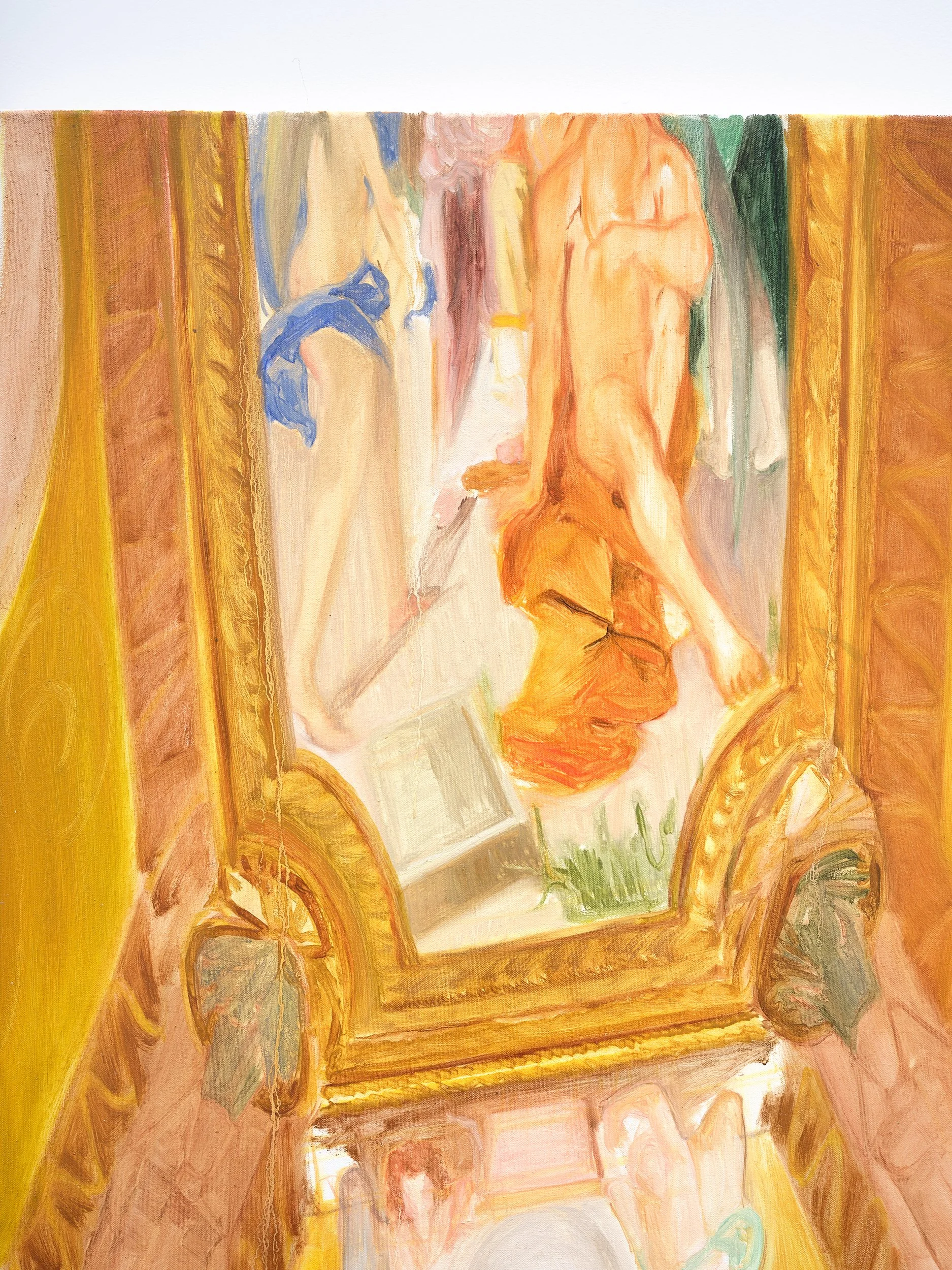
brunelle dias primbs plastic fresco i: rapture, 2026 (detail) Oil on canvas 900 x 1500
Not the ray that strikes but the ray that shines is a commissioned essay by Jonathan Rankin on the occasion of mysterium rationis by brunelle dias primbs.
“There are two ways of getting home; and one of them is to stay there. The other is to walk round the whole world till we come back to the same place.”
– G.K. Chesterton
The desire for home is Janus-faced. Home evokes return and departure, memory and dream, ties that bind and bonds that hold. In mysterium rationis, the mirage-like presence of home shimmers in every painting. Yet, far from any notion of bourgeois cosiness, the presence and promise of home in brunelle dias primbs’ work speaks to bigger questions of being and belonging in the world. Here, home is no suburban container; it is existential and biographical, stretching across worlds and time.
Born from an experience of travelling to Portugal, Spain and Italy in 2025 with her mother, mysterium rationis stands as a record of discrete moments where dias primbs encountered the interpenetration of home and exile, as well as attendant questions of faith and reason, grace and scepticism, desire and indifference. These moments speak in their own way to the presence of the permanent in the temporal and the eternal in the ephemeral. It is fitting, then, that this exhibition would be contained in a gallery called Grace located in the Rationalist House. dias primbs is right at home amongst the contradictions.
So too the title of the show, mysterium rationis, plays with the ancient words uttered by the priest during the traditional Latin Mass (mysterium fidei! - the mystery of faith!). This decision by dias primbs acts as an invitation to face the limits of human knowing whilst gesturing toward the possibility of some mystery, perhaps the grace of a homecoming, waiting within the works. Born and raised in the Catholic tradition, dias primbs returns to the religion of her mothers and grandmothers in mysterium rationis, not as a devotee but neither as a sceptic. Instead, dias primbs explores the edges between belief and unbelief, sacred and profane. In this sense, her painterly approach illuminates and reflects the subject matter itself. As a figurative painter, dias primbs has long been interested in the interplay between figure and ground, asking the question, what happens in the spaces where figure and ground approach and blur? There is mystery here, that much is certain.
In my conversations with brunelle in the lead-up to this show, we discussed the notion of sacramentalism and whether the work in mysterium rationis could be seen as fitting within a sacramental ontology. The use of the word mystery (μυστήριον translated into Latin as sacramentum) seems to be a dead giveaway; so too does the frequent appearance of religious spaces, rituals, and figures. In his book The Catholic Imagination, Fr. Andrew Greeley writes how Catholics
“live in an enchanted world, a world of statues and holy water, stained glass and votive candles, saints and religious medals, rosary beads and holy pictures. But these Catholic paraphernalia are mere hints of a deeper and more pervasive religious sensibility which inclines Catholics to see the Holy lurking in creation. As Catholics, we find our houses and our world haunted by a sense that the objects, events, and persons of daily life are revelations of grace.”
In works like souvenir i: rapture, plastic fresco ii: capture and plastic fresco iii: is this it? dias primbs invites us to squeeze in beside her and crane our necks up at the ceiling to see if there might be something lurking in the corners, around the edges, or perhaps haunting the very centre of what we are beholding. The skewing and bending of the image is true to the memory of the moment; it makes viewing these works a participatory act. It also invites a posture of humility as we renounce our preference for standing over and apart from what we are seeing. We must stoop to see these works and in so doing we are invited to relinquish our habituated modes of relating to the world as “I and it” and instead take up the language of “I and Thou.”
Again, in conversation with brunelle, she recounts the way her initial instinct in encountering the crowds of tourists, the contrived religiosity and general gaudiness of the spectacle was to feel a certain snobbishness about it all; a desire to stand apart and wash her hands of it. This was no homecoming; on the contrary, it only deepened the sense of exile. And yet, brunelle describes the way the presence of her mother Beverley, with her willingness to open herself to encounter, afforded brunelle the grace to look again with “soft eyes.” This way of seeing marks all the works in mysterium rationis. Each work invites metanoia –a conversion of sight.
Mysterium rationis is peopled by animals. This too is a deliberate decision by dias primbs to decentre the human/humanistic in order to find grace in the more-than-human world. Birds, monkeys and horses are given positions of prominence throughout dias primbs’ work, none more so than in but the flesh where once again we are invited to lift our eyes to find ourselves at home in a society of creatures. The title of this work harkens back to a saying of Jesus from the Gospel of Mark, “watch and pray that you may not undergo the test. The spirit is willing but the flesh is weak.” In the context of mysterium rationis, this feels less like failure and more like a decision to embrace the fleshiness of being human. Again, this suggests the presence of a sacramental tapestry woven throughout the work. Leonardo Boff, writing on the indicatory and revelatory functions of the sacramental realm, suggests
“the transparence of the world with respect to God is what enables us to understand sacramental structure and sacramental thinking. It tells us that God is never reached directly in and by self. We always reach God together with the world and the things of the world which are diaphanous and transparent with respect to God. Hence experience of God is always a sacramental experience. In things we experience God. The sacrament is part of the world, but it holds within it another world.”
brunelle dias primbs God of my mothers, 2026 Oil on board 230 x 300
In other words, a sacramental outlook excludes nothing from the chorus of voices that speak of the mystery at the heart of all things; mass-produced glow-in-the-dark souvenir madonnas remain forever opaque and merely immanent to those who step back from the threshold of the mystery of reason, but for those who look again, even these plastic souvenirs begin to hum as a revelation of grace; a surfacing of the mystery of the Absolute that lives and annunciates and shines through everything. dias primbs seems to recognise that. Perhaps it sits at the heart of her decision to use a 13th-century gesso recipe to represent these souvenirs in God of my mothers ; a decision that elevates what others see as cheap or worthless.
This essay began with a quote from G.K. Chesterton about the two ways of getting home. While each of the paintings in mysterium rationis speaks to the longing for home only one painting in the collection depicts the renewed vision that comes from return. In hotline, dias primbs captures the moment a small bonfire briefly threatened to spread into the garden of her Port Albert home. In what might seem a fairly unremarkable event, dias primbs noticed the presence of something in the flame. Something diaphanous, something transparent, something sacramental. Ultimately, all the works in mysterium rationis are burning bushes –transfigurations of home and beacons that call us to go beyond the edge of our knowing.
Portrait of Jonathan Rankin
Jonathan Rankin is a cultural geographer, minister, and amateur theologian. He has previously published work in the New Zealand Geographer and Social and Cultural Geography on the phenomenology of islands. He lives in Swanson with Sarah and their children.